Workshops:
hmtmh: Ghost Tones Captured in a Khipu 19.-22.11.2024 Incontri Hannover
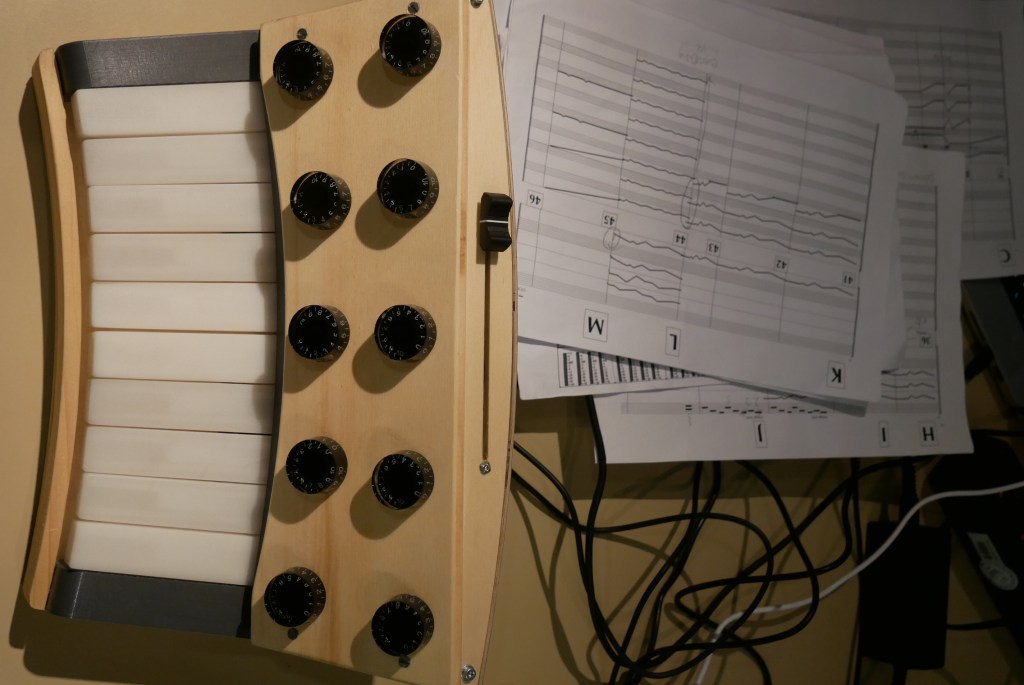
Khipu, a pre-Hispanic textile computing system, is interwoven with the live electronic setup used to create I of VI, an early live electronic tape piece by Pauline Oliveros. In the three-day workshop the collaborators will share insights into the historical references and their hybridisation into a new instrument. This workshop disseminates the results of a collaborative project between Constanza Pina and Dustin Zorn. The collaboration has tied together several artistic practices to create a new live electronic instrument. Tactile, technological and cultural perspectives on the instrument will be experienced and discussed with participants. Students will gain hands on knowledge about the live electronic instruments designed in the project and are encouraged to share their own artistic perspective in the process. A final concert will conclude the workshop showcasing the artistic outcome of collaboration and workshop
mdw vienna: „Welcome to the jungle“ Di, 30.April 2024, 10-12 Uhr
Future Art Lab, Vortragssaal VZG48
This lecture discusses L-systems as generative algorithms for composition. Originally developed in 1968 by the biologist and botanist Aristid Lindenmayer at the University of Utrecht, these algorithms were used to model growth processes of plants. Starting from an axiom, these algorithms grow recursively by applying production rules.
Through a series of iterations, they replace parts of their own structure. Recursion and self-similarity allow these systems to generate computer graphics for plants and fractals.
L-systems provide a way to generate complex structures from small sets of rules of a formal grammar. By working with representations, these systems are open to being used to generate musical structures. Since their development, L-systems have been used by a number of different composers to develop musical material within their pieces.
In this talk we will look at how different composers use L-systems in the musical context of their compositions. By analysing the grammar of the systems, their musical mapping and the relationship to the aesthetic realisation within a specific composition, we will explore the possibilities and limitations of L-Systems.
The representational nature of L-systems provides a method for growing small particles into larger musical structures, while maintaining a consistent relationship between their smallest parts and their overall form. But interpreting the structural formalism raises a number of important questions:
What can a musical particle be to begin with?
What are obvious or interesting forms of musical development?
How can these musical ideas be developed into a set of abstract rules?
How can a composer remain in an active position, „controlling“ and „guiding“ the growth of the system?
Through the thicket of systems and questions concerning their musical interpretation, we will try to reach a profound understanding of the use of L-systems as a compositional process.
mdw vienna „Let the algorithm grow“ Di, 12.December 2023, 10-12 Uhr Future Art Lab, Vortragssaal VZG48
This lecture discusses cellular automata and L-systems as two „classical“ generative algorithmic principles. By exploiting the emergent behaviour of algorithms based on simple rules, it is possible to challenge one’s own aesthetic perspective through a repetitive game of critically listening and adjusting the rules of a system to produce a desired result. The need to formulate rules creates knowledge about the changing algorithm as well as its editor, providing a potentially ever-growing mirror for artistic self-reflection.
What sparks our interest in form through aesthetic experience, and what remains an abstract application of rules without further benefit? How do our expectations of what is possible with a given tool and what we hope to hear by using it in a particular way change? What can we learn about ourselves by observing, changing and interpreting algorithmic rules? When and why do we break the rules?
The different sets of rules inspired by Conway’s Game of live have produced a series of two-dimensional worlds inhabited by curious creatures that thrive and perish in a metronomic sequence of states. By implementing and interpreting the behaviour of these systems as a basis for musical experimentation, we give them agency in our own artistic endeavours. Mapping one world onto the other becomes a recursive process and a first step in allowing us to observe the implications of our actions from two perspectives.
L-Systems will give us a second way of creating complex structures from small sets of rules.By applying production rules, these algorithms grow recursively, replacing parts of their own structure, represented by symbols, through a series of steps. Assigning musical „seeds“ to these symbols will provide us with a method of growing small particles into larger musical structures, while maintaining a consistent relationship between their smallest parts and their overall form. While this consistency may be attractive for a particular musical structure or model, the most important question of self-observation remains: When and why will we break our self-imposed rules?
Seminars:
Analyse-Seminar: Musik des 20./21.Jahrhunderts – Zusammenspiel: Live-Elektronik und Instrumente
montags, 16:00-18:00 Uhr
HfM Hanns Eisler Berlin, Charlottenstraße 55
This semester we will be exploring pieces of computer music, tape music and live electronics. We follow the works and aesthetics of different composers from the beginnings of live electronics and computer music to today’s performance practice. The focus is on the organisation of musical material without recourse to instruments in the traditional sense. In the seminar we will examine technological and aesthetic discourses and the search for new possibilities of expression in their interplay.
Crossmodulations WS 2023/2024 Klangzeitort Berlin
Im Praxis Seminar Crossmodulations treffen Studierende der Instrumentalstudiengänge, sowie Komponist*innen von Udk und Hfm aufeinander. Durch die Verknüpfung von experimenteller Live-Elektronik und experimentellem Instrumentalspiels soll eine gemeinsame musikalische Praxis entstehen. Die Studierenden setzen sich mit alternativen Formen, Instrumente zu bespielen auseinander; die hierbei entstehenden Klänge werden durch von Studierenden entwickelte Setups live elektronisch bearbeitet. Die Netzwerke akustisch instrumentaler und live-elektronisch instrumentaler Aktionen verknüpfen die Musizierenden über die medialen Grenzen hinaus. Ziel ist es, ohne spezifische Vorkenntnisse, gemeinsam experimentelle und virtuose Spielsituationen zu erarbeiten, zu erkunden und auf Basis dieser Erfahrungen zu modifizieren. Der Werkbegriff als Ausdruck eines*r einzelnen Künstlers*in wird im Rahmen des Kurses durch ein kollektives Arbeiten ersetzt, in dem die Teilnehmenden in unterschiedlichen Rollen Strategien entwickeln, um musikalisch zu handeln. Abschluss des Seminars ist ein Werkstattkonzert. Das gemeinsame Experimentieren und voneinander Lernen steht im Fokus des Kurses.
 dustin zorn